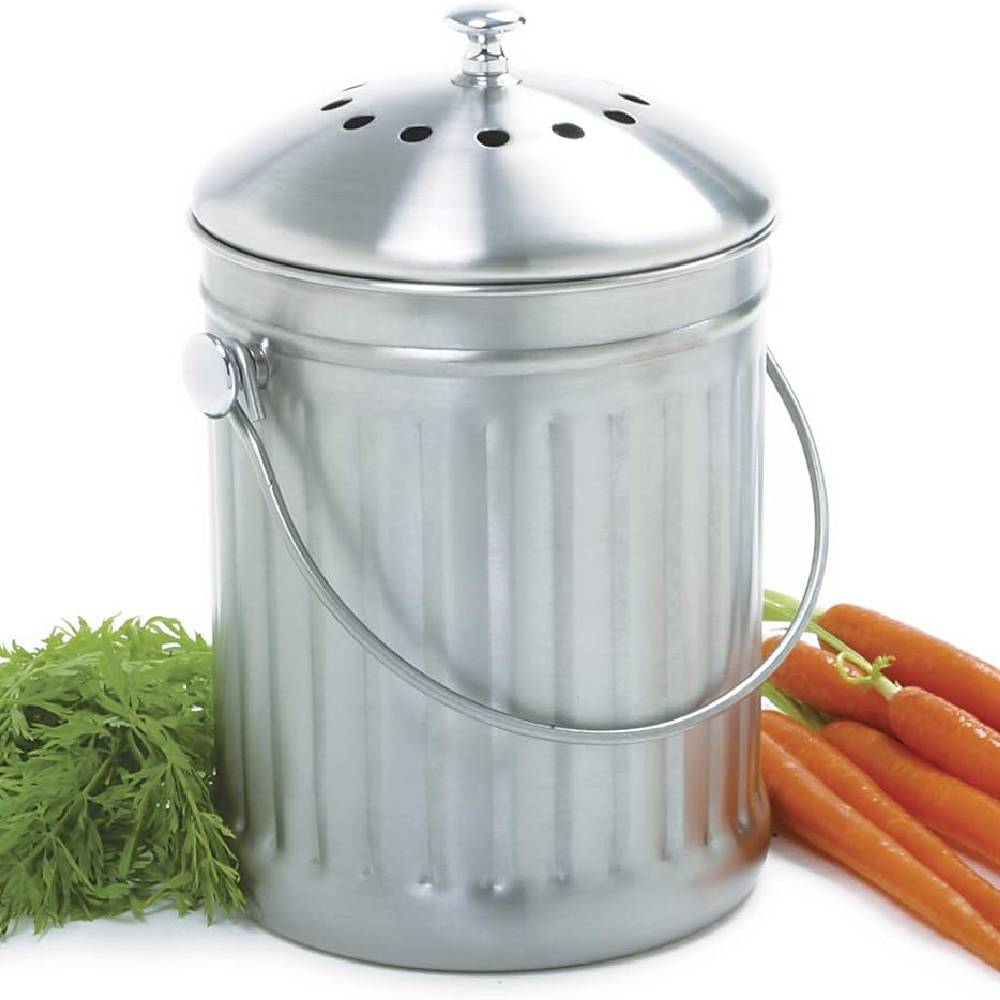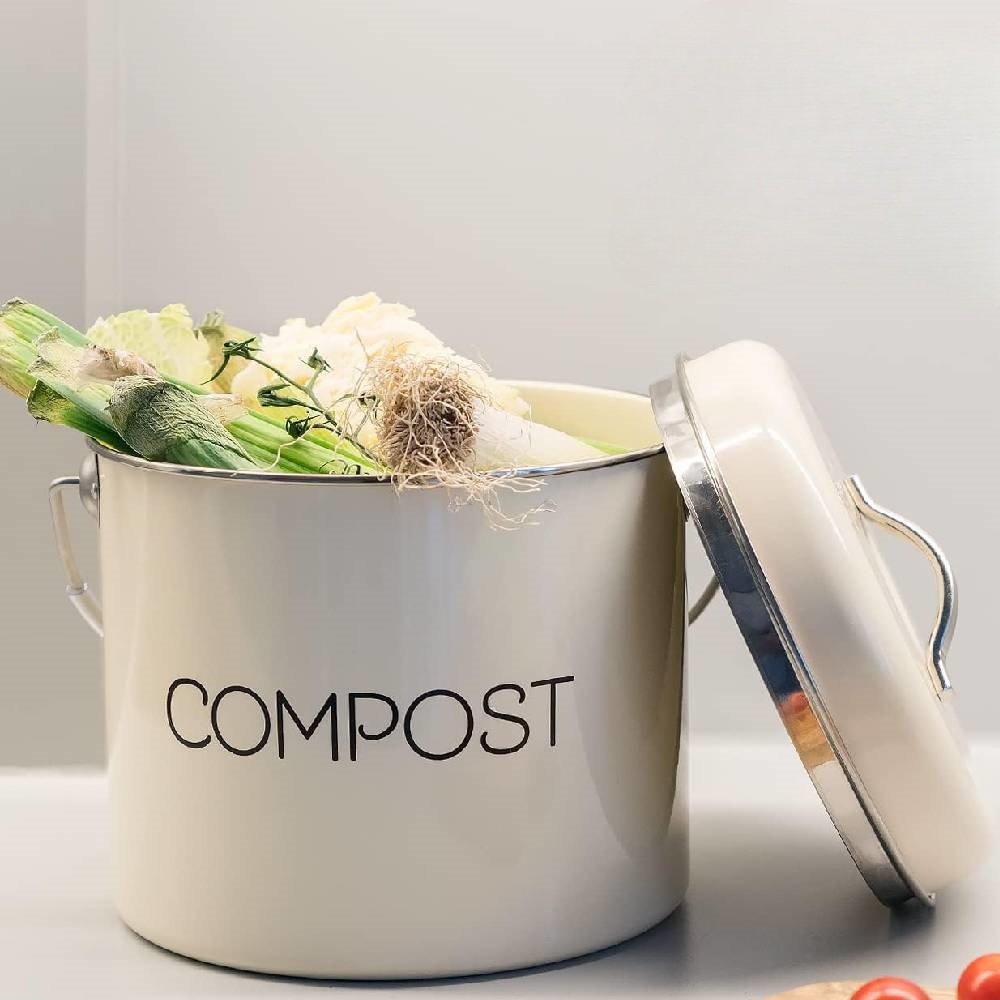
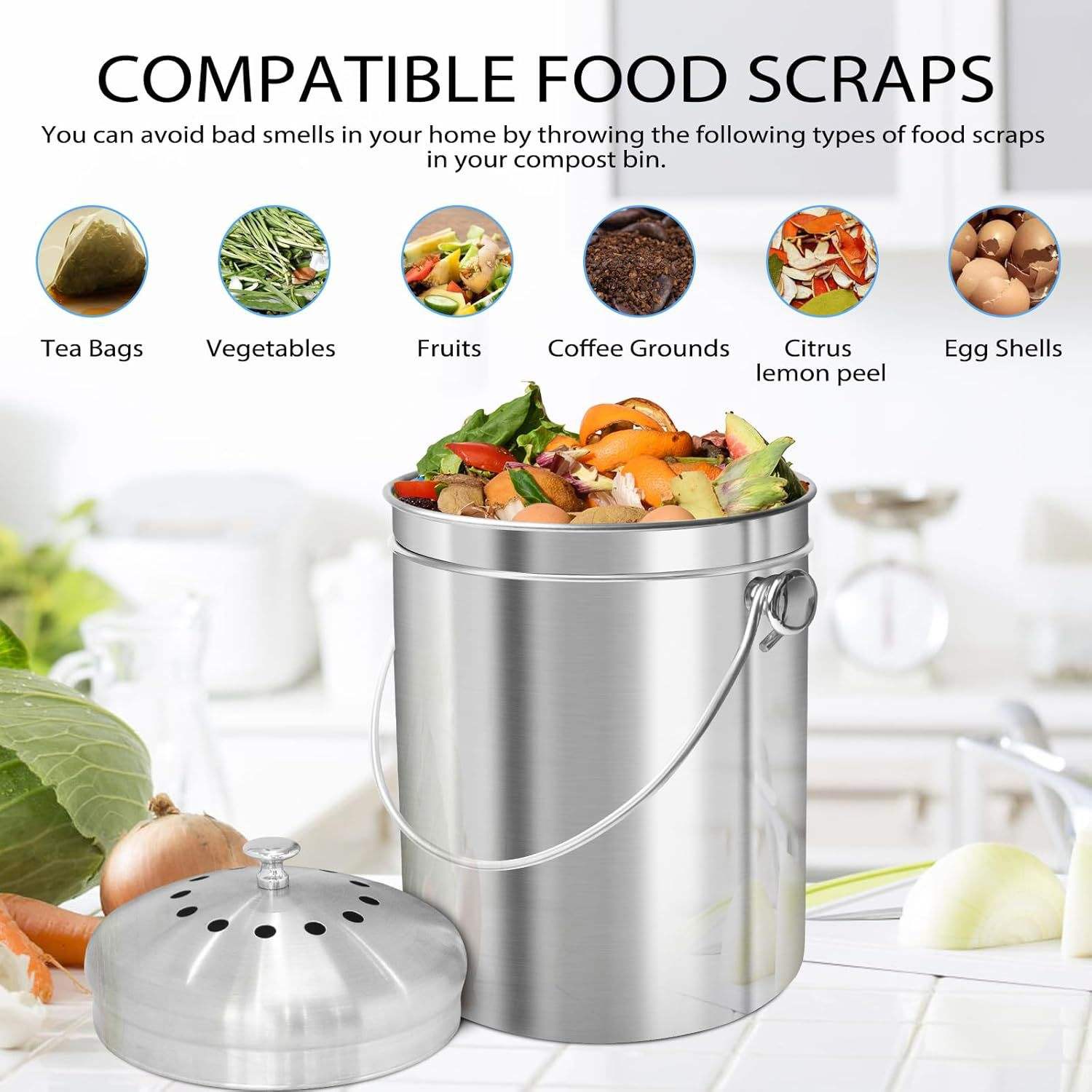
When sourcing 201 stainless steel compost bins for wholesale or retail programs, buyers should look beyond appearance and unit price. Material verification, sheet thickness, forming quality, welding, surface finishing, lid fitting, odor-control components, and export packaging all affect the final product’s performance and commercial value.
For importers, supermarket buyers, kitchenware distributors, and private-label brands, choosing the right stainless steel compost bin manufacturer is essential to maintaining consistent product quality and controlling purchasing costs. This guide explains the key inspection points buyers should consider before approving samples and placing bulk orders.
1. Why 201 Stainless Steel Is Used in Kitchen Compost Bins
Material selection is one of the first decisions buyers need to evaluate when developing a stainless steel kitchen compost bin.
201 stainless steel is a cost-effective material commonly used in household products, kitchen storage containers, and decorative metalware. It offers good strength, formability, and an attractive appearance when properly processed and maintained.
For countertop compost bins designed for ordinary indoor household use, 201 stainless steel can be a practical option for brands looking to balance product appearance, manufacturing cost, and retail positioning.
Understanding the Characteristics of 201 Stainless Steel
- Cost efficiency: Generally more economical than 304 stainless steel, making it suitable for price-sensitive wholesale programs.
- Mechanical strength: Provides useful strength and durability for everyday household applications.
- Formability: Suitable for common metal forming and fabrication processes used in kitchenware production.
- Surface appearance: Can achieve brushed, polished, and other decorative finishes.
- Corrosion resistance: Offers corrosion resistance under appropriate indoor conditions, although it is generally less resistant than 304 stainless steel, particularly in chloride-rich or humid environments.
Buyers should understand that 201 stainless steel is not identical to 304. It should not be marketed as a direct substitute in every application. For countertop compost bins, the suitability of the material depends on the intended environment, product construction, maintenance requirements, and target price point.
Before placing an order, buyers should clearly confirm the material grade with their supplier and ensure that the approved specification matches the production materials.
2. Material Verification: Do Not Rely on Appearance Alone
One common purchasing mistake is assuming that stainless steel grades can be identified simply by looking at the finished product.
In reality, 201 and 304 stainless steel can have very similar appearances after polishing or brushing. Visual inspection alone cannot reliably establish the material grade.
What Buyers Should Request
Before mass production, importers should discuss the following material verification procedures with their supplier:
- Material specification: Confirm that the agreed material is 201 stainless steel.
- Material certificate: Request a material test certificate or relevant supplier documentation where available.
- PMI testing: Use Positive Material Identification equipment when independent grade verification is required.
- Batch traceability: Maintain appropriate records connecting incoming materials with production batches.
For larger wholesale orders, material verification should be included in the purchasing specification rather than left as an informal agreement.
Why Material Consistency Matters
Using inconsistent materials between production batches can create differences in forming performance, surface appearance, and corrosion resistance.
For private-label brands, these variations may result in customer complaints, product returns, and unnecessary quality disputes.
A professional compost bin supplier should be able to explain its incoming material inspection procedures and provide supporting documentation according to the buyer’s requirements.
3. Sheet Thickness and Structural Stability
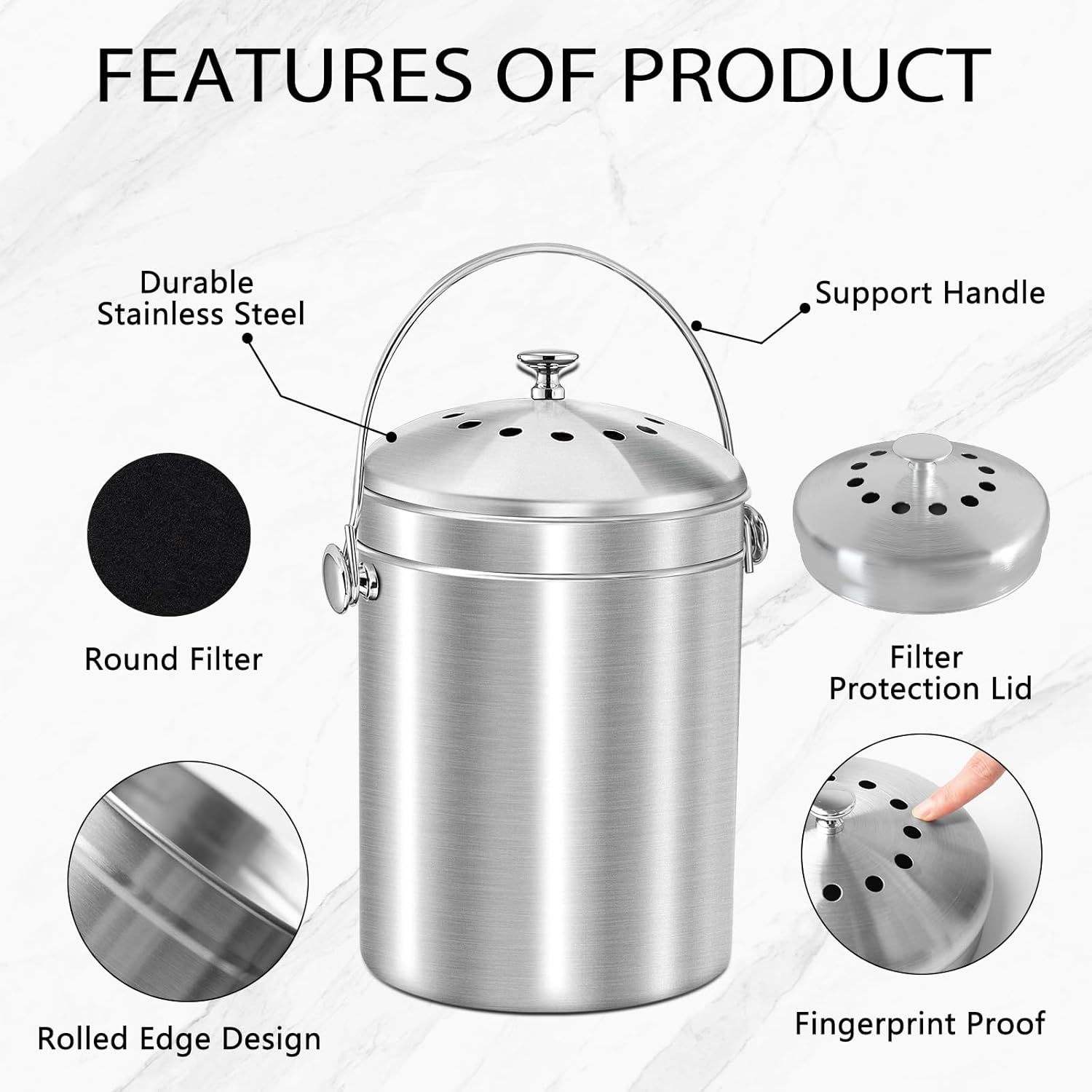
Material thickness directly influences the structural performance and perceived quality of a stainless steel compost bin.
If the body is too thin for its design, the product may feel lightweight, deform under normal handling, or become easily dented during transportation. Excessive thickness, on the other hand, can increase material costs and affect the final wholesale price.
 What Buyers Should Evaluate
There is no universal sheet thickness suitable for every compost bin. The appropriate specification depends on capacity, body diameter, height, forming method, and structural design.
When reviewing a sample, buyers should check:
- Whether the body maintains a stable cylindrical or specified shape.
- Whether the side wall feels sufficiently rigid during normal handling.
- Whether the bottom remains securely attached and stable.
- Whether the rim maintains its shape without excessive deformation.
- Whether the lid and body remain properly aligned.
Buyers should request the actual material thickness specification, including the agreed tolerance, before confirming an order.
For OEM projects, it is better to establish a documented thickness requirement during sample approval than to rely on general descriptions such as heavy-duty or premium quality.
4. Body Forming and Welding Quality
The manufacturing process has a direct influence on the appearance, durability, and consistency of stainless steel compost bins.
Even when the correct stainless steel material is used, poor forming or welding can reduce the overall quality of the finished product.
Body Forming Inspection
During sample evaluation, buyers should examine the following areas:
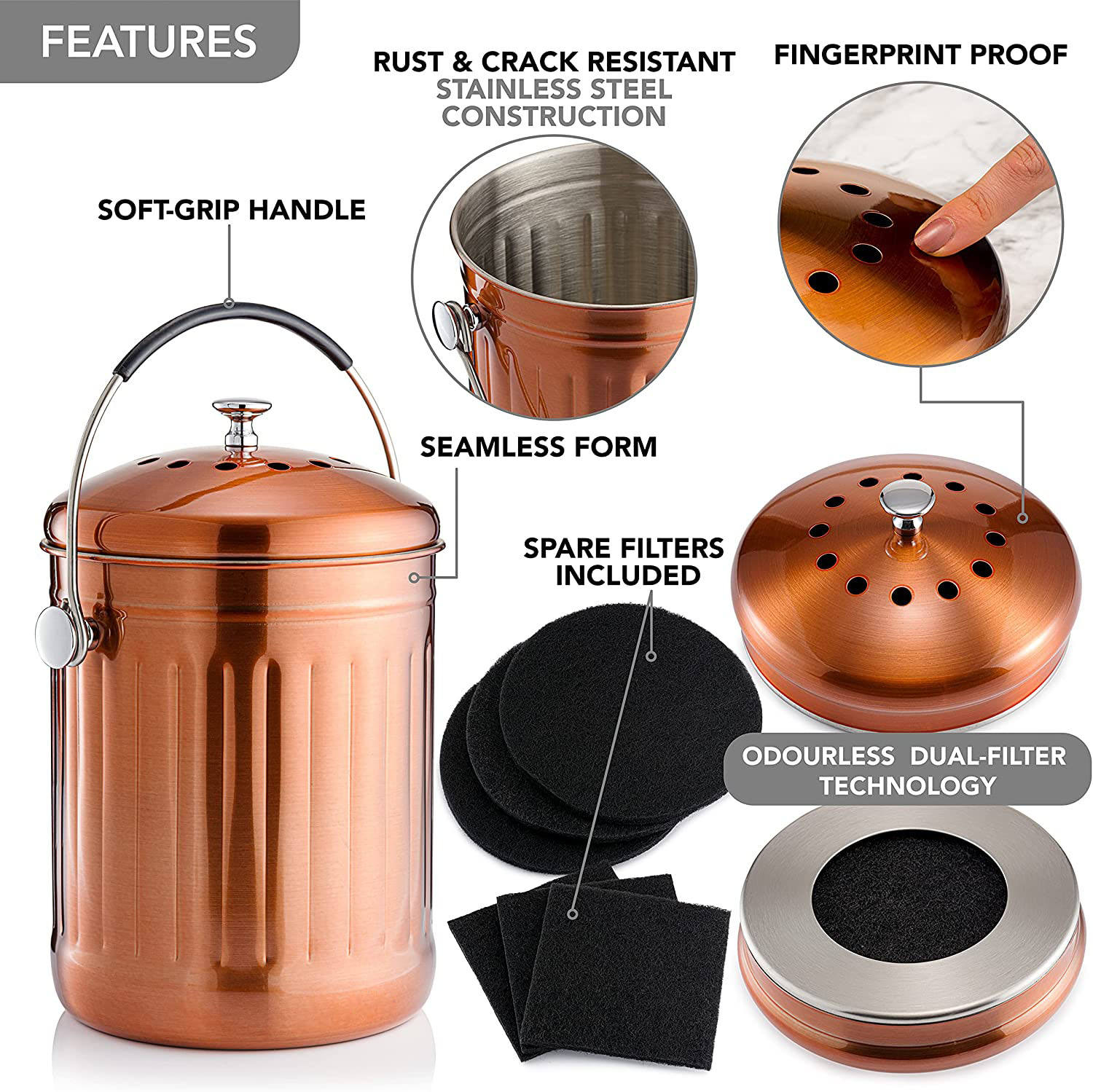
- Roundness: The body should maintain a consistent shape without visible distortion.
- Wall uniformity: The side wall should not show obvious dents, wrinkles, or uneven forming marks.
- Bottom connection: The bottom should be properly fitted and securely connected to the body.
- Rim finishing: The upper edge should be smooth, even, and free from sharp burrs.
- Dimensional accuracy: Product height, diameter, and other critical dimensions should match the approved drawing or sample.
 Welding and Joint Inspection
For compost bins with welded body seams, handles, or other metal components, welding quality should be carefully checked.
Common defects include:
- Visible pinholes or incomplete welds.
- Uneven welding marks.
- Excessive grinding marks around joints.
- Sharp edges or rough finishing.
- Visible discoloration caused by insufficient finishing treatment.
For products with a polished or brushed finish, welding areas should be processed carefully to maintain a consistent appearance.
Importers should inspect both the external and internal surfaces where accessible, since defects inside the product can also affect cleaning and everyday use.
5. Surface Finish: Appearance and Practical Performance
Surface finishing is an important selling point for countertop compost bins because consumers often keep these products visible in their kitchens.
For retailers and private-label brands, finish consistency can influence customer perception just as much as the product design itself.
Common Surface Finish Options
| Surface Finish | Appearance | Commercial Application |
|---|---|---|
| Brushed Finish | Subtle directional texture | Modern kitchen collections |
| Mirror Polish | Bright and reflective | Traditional and premium product lines |
| Matte Black Coating | Contemporary and understated | Modern retail collections |
| White Coating | Clean and minimalist | Neutral kitchen storage ranges |
| Custom Color Coating | Brand-specific appearance | OEM and private-label programs |
How to Inspect Surface Quality
Before approving a production sample, buyers should check:
- Whether the finish is consistent across the entire body.
- Whether visible scratches, dents, or polishing marks are present.
- Whether the coating has bubbles, peeling, or uneven color.
- Whether the surface around the rim and bottom is properly finished.
- Whether the color matches the approved reference sample.
For colored compost bins, buyers should also agree on the coating specification and appropriate adhesion or abrasion tests according to the product requirements.
For brushed stainless steel models, the direction and texture of the brushing should remain consistent between production batches.
6. Lid Design and Fit: Small Details That Affect User Experience
The lid is one of the most important functional components of a kitchen compost bin. A poorly designed lid can make the product inconvenient to use, even when the stainless steel body is manufactured correctly.
Key Lid Inspection Points
- Fit: The lid should sit evenly on the body without excessive gaps or instability.
- Handling: The lid should be easy to remove and replace.
- Edge finishing: Metal edges should be smooth and safe to handle.
- Weight: The lid should have an appropriate weight for its design and intended use.
- Alignment: The lid should not tilt noticeably when placed on the container.
Different Lid Options for Retail Programs
Depending on the product design, buyers may consider:
- Traditional stainless steel lids.
- Stainless steel lids with filter compartments.
- Bamboo lids combined with stainless steel bodies.
- Fitted lids with replaceable charcoal filters.
Each option offers a different balance of appearance, functionality, and production cost. Buyers should evaluate the complete assembly rather than approving the lid and body separately.
7. Charcoal Filter Performance and Odor-Control Design
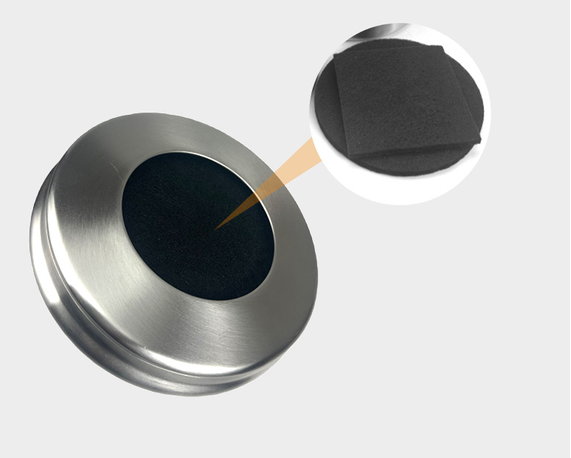
Many countertop compost bins include activated charcoal filters to help reduce unpleasant odors from stored food scraps.
However, not all filter systems provide the same performance. The filter material, size, thickness, ventilation design, and lid construction can all affect the overall odor-control experience.
What Buyers Should Check
- Filter material: Confirm that the insert uses activated charcoal or another specified odor-adsorbing material.
- Filter dimensions: Ensure the filter fits securely inside its designated compartment.
- Replacement design: Check whether consumers can remove and replace the filter conveniently.
- Airflow: Evaluate whether the filter compartment allows appropriate air contact.
- Accessory availability: Confirm whether replacement filters can be supplied for future retail orders.
Buyers should avoid assuming that a charcoal filter makes a compost bin completely odor-proof. Filter performance depends on food waste type, moisture, storage time, ventilation, and maintenance.
For private-label projects, it is advisable to evaluate the filter together with the complete lid assembly and approve the finished product through practical use testing.
8. Quality Control Checklist Before Mass Production
Before approving a bulk order, buyers should establish a clear quality inspection checklist with their stainless steel compost bin manufacturer.
The following table provides a practical reference for incoming inspection and pre-shipment quality checks.
| Inspection Item | What to Check | Common Defects |
|---|---|---|
| Material | Confirm specified 201 stainless steel | Incorrect or inconsistent material |
| Dimensions | Verify height, diameter, and capacity | Out-of-tolerance dimensions |
| Body | Check roundness and structural stability | Dents and deformation |
| Welding | Inspect joints and connections | Pinholes and rough welds |
| Surface | Check finish and color consistency | Scratches and uneven coating |
| Lid | Check fitting and opening operation | Loose or misaligned lid |
| Filter | Verify fit and replaceability | Loose or damaged filter |
| Packaging | Check protection and carton condition | Insufficient protection |
When Should Inspections Take Place?
A reliable quality control process should cover multiple production stages:
- Incoming Material Inspection: Verify the specified stainless steel material and check incoming components.
- In-Process Inspection: Monitor forming, welding, grinding, and surface finishing.
- Assembly Inspection: Check lid fitting, filter installation, and overall functionality.
- Final Inspection: Examine finished products for appearance, dimensions, workmanship, and accessories.
- Pre-Shipment Inspection: Check product quantities, labeling, carton specifications, and packaging quality before shipment.
For larger orders, buyers may also arrange third-party inspections based on an agreed sampling plan, such as the applicable AQL inspection standard.
9. Packaging Requirements for Wholesale and Export Orders
Packaging is another important consideration when sourcing stainless steel compost bins from overseas manufacturers.
Although stainless steel is durable, polished and coated surfaces can still be scratched or damaged during transportation if products are not adequately protected.
Common Packaging Components
- Individual protective polybags.
- Foam or suitable protective inserts.
- Paper dividers between metal components.
- Retail color boxes or customized gift boxes.
- Export master cartons.
For retail projects, packaging should also include the necessary product information, barcode labels, product descriptions, and instruction manuals where required.
Before confirming packaging specifications, buyers should evaluate carton strength, product positioning, internal protection, and container loading efficiency.
For long-distance shipments, the packaging should be tested or assessed according to the transportation risks and the buyer’s requirements.
10. Questions to Ask Before Choosing a 201 Stainless Steel Compost Bin Supplier
Finding a suitable supplier involves more than comparing quotations. Buyers should understand the manufacturer’s production capabilities, quality management, and OEM support before committing to a long-term purchasing relationship.
Here are some important questions to discuss:
- Can you confirm that the product is manufactured using 201 stainless steel?
- Can you provide material documentation or arrange material verification?
- What sheet thickness and dimensional tolerances are available?
- Can you provide different capacities and surface finishes?
- Can the logo and retail packaging be customized?
- Do you offer charcoal filter accessories?
- What quality inspection procedures are followed during production?
- Can you provide a pre-production sample before bulk manufacturing?
- What are your MOQ and standard production lead times?
- Can you support mixed-product orders and export packaging requirements?
A professional compost bin manufacturer should be able to provide clear answers and discuss practical solutions based on the buyer’s product specifications and target market.
11. How to Reduce Sourcing Risks When Developing a Private Label Compost Bin
For retailers and private-label brands, the first production order is an important step in establishing a new product category. A well-organized approval process can prevent unnecessary changes and reduce the risk of quality disputes.
Step 1: Prepare a Clear Product Specification
Define the material grade, body dimensions, capacity, thickness, surface finish, lid design, filter requirements, logo position, and packaging specifications.
Step 2: Request a Physical Sample
Evaluate the actual product rather than relying entirely on photographs or catalog descriptions. Check its appearance, construction, functionality, and overall workmanship.
Step 3: Confirm the Approved Sample
Keep a signed or otherwise documented reference sample. Any changes to material, dimensions, finish, or components should be discussed and approved before mass production.
Step 4: Establish Inspection Standards
Agree on acceptable quality levels, critical dimensions, visual standards, functional checks, and packaging requirements.
Step 5: Monitor Mass Production
Maintain communication with the supplier during production and arrange inspections when necessary. This helps identify potential problems before the products are packed and shipped.
Following these steps gives buyers better control over product consistency and makes future repeat orders easier to manage.
Frequently Asked Questions
Is 201 stainless steel suitable for kitchen compost bins?
Yes. 201 stainless steel can be suitable for countertop compost bins intended for ordinary indoor household use. It offers a cost-effective combination of strength, formability, and appearance. However, it has lower corrosion resistance than 304 stainless steel, so proper material selection, surface finishing, cleaning, and maintenance are important.
How can buyers identify genuine 201 stainless steel?
Visual inspection cannot reliably distinguish 201 from 304 stainless steel. Buyers should request material documentation and consider Positive Material Identification (PMI) testing when independent verification is necessary.
Does the thickness of a stainless steel compost bin matter?
Yes. Sheet thickness affects structural rigidity, weight, forming performance, and manufacturing cost. The appropriate thickness depends on the product dimensions and construction. Buyers should specify an agreed thickness and tolerance before production.
Can 201 stainless steel compost bins rust?
Yes. Although 201 stainless steel has corrosion resistance, it is not rust-proof. Prolonged exposure to moisture, salt, acidic residues, or unsuitable cleaning chemicals may cause staining or corrosion. Regular cleaning and drying help maintain its appearance.
Which surface finish is best for wholesale compost bins?
Brushed stainless steel is a versatile option for many kitchenware collections. Matte black, white, and other coated finishes are also popular choices for private-label projects. The best option depends on the retailer’s target customers, brand positioning, and budget.
Do stainless steel compost bins need charcoal filters?
Not every compost bin requires a charcoal filter, but it is a useful optional feature for countertop models. Activated charcoal can help adsorb unpleasant odors when the filter is properly designed and maintained.
Can manufacturers customize stainless steel compost bins?
Yes. Depending on the manufacturer’s capabilities, OEM options may include custom colors, laser logo engraving, surface finishes, lid designs, charcoal filter configurations, retail packaging, and barcode labels.
What should importers check before placing a bulk order?
Importers should confirm material grade, sheet thickness, product dimensions, body construction, surface quality, lid fitting, filter components, packaging specifications, MOQ, lead time, and inspection standards before approving mass production.
Conclusion
Sourcing a reliable 201 stainless steel compost bin requires careful attention to both material specifications and manufacturing details. Buyers should evaluate material verification, sheet thickness, forming quality, welding, surface finishing, lid construction, odor-control components, and export packaging before placing a wholesale order.
For importers, distributors, supermarkets, and private-label brands, a clear product specification and a well-organized sample approval process are essential for maintaining consistent quality across production batches.
Rather than choosing a supplier based on price alone, buyers should look for a manufacturing partner that understands product requirements, provides practical customization options, and maintains consistent quality control.
Looking for a Reliable Stainless Steel Compost Bin Manufacturer?
At Jiangmen Yesheng Import and Export Trade Co., Ltd., we specialize in stainless steel kitchenware manufacturing and wholesale supply for international markets.
Our product range includes stainless steel compost bins, bread bins, kitchen storage canisters, bag savers, French presses, mixing bowls, coffee pots, and other household products.
We understand the needs of importers, wholesalers, retailers, and private-label brands, including product specifications, surface finishing, logo customization, packaging, and export requirements.
Whether you are developing a new kitchen storage collection or looking for a reliable supplier for an existing product line, we welcome you to discuss your requirements with our team.
Looking for a professional stainless steel compost bin supplier in China? Visit www.jmyesheng.com to explore our product range and contact us for wholesale and OEM cooperation.